As vacancy splits between winners and losers, low-capex fit-out upgrades are becoming the fastest way for developers to move secondary stock into the part of the market where tenant demand actually is
The national office vacancy numbers released in mid-2026 make for grim headline reading. Vacancy across Australian CBDs hit 16.1% in the six months to June, the highest rate since the pandemic and, on some measures, since the early 1990s recession. There is now more empty office space in this country than there was at the height of COVID lockdowns.
But that single number hides a much more useful story for anyone who owns, develops, or fits out commercial space: this is not a uniform downturn. It is a sorting exercise. While the headline vacancy rate climbed, premium and A-grade vacancy actually fell 1.2 percentage points to 10.2%. As Property Council of Australia CEO Mike Zorbas put it, the market “has moved from the correction phase to the recovery phase, but it remains a story of quality and location.” Tenants aren’t leaving the office market. They’re leaving buildings that no longer earn their commute.
Adelaide is the sharpest illustration of this split. CBD vacancy there rose from 15.5% to 16.3% over the six months to July, but that overall number masks two very different markets moving in opposite directions. C-grade vacancy surged from 12.1% to 19.1%, while A- and B-grade buildings recorded positive demand and enquiry levels hit record highs, up 40% in the June quarter alone. Bruce Djite from the Property Council of Australia’s SA division didn’t mince words about what happens to the losers in this split: “Vacant buildings don’t just affect landlords. They reduce foot traffic, impact surrounding businesses and ultimately make the city centre less vibrant.” Older stock isn’t just underperforming financially. It’s dragging down the precincts around it.
What tenants are actually buying
Strip away the grade letters and the enquiry data points to something fairly concrete: businesses are consolidating into buildings that support how people actually want to work now. That means better building performance, yes, but increasingly it also means the fit-out itself: spaces designed for flexibility, for a mix of focused and collaborative work, and for a workplace culture strong enough to justify the commute. Djite’s language is telling: tenants want buildings with “superior building design to support attendance and productivity,” not just a lower square-metre rate.
This mirrors what’s happening in flight-to-quality markets internationally. Landlords competing for tenants are increasingly building out spec suites and demonstration fit-outs before a tenant even signs, specifically to prove the space works for hybrid teams. Industry commentary on this trend is consistent on one point: the amenities that move the needle aren’t lobby upgrades or gyms anymore, they’re the everyday, function-first spaces people actually use between meetings, on calls, and when they need to think together. As Lauren Wilson of BR Design Associates put it in an interview on the trend, café and collaboration focal points are “what really make a space feel special” when they’re designed in deliberately rather than added as an afterthought.
The retrofit case for booths and writable surfaces
This is where premium acoustic booths and whiteboard or writable wall surfaces earn their place in the conversation, and why they matter more to developers right now than they might have five years ago.
Neither is a structural intervention. Both can be installed into existing floor plates, in older B- and C-grade stock as well as new builds, without the capital outlay of a full re-core or facade upgrade. That matters enormously in a market where the buildings most at risk of being “ditched,” to use the Adelaide framing, are exactly the ones that can’t justify a ground-up redevelopment but desperately need a credible answer to “why would a tenant choose us over the new tower down the road.”
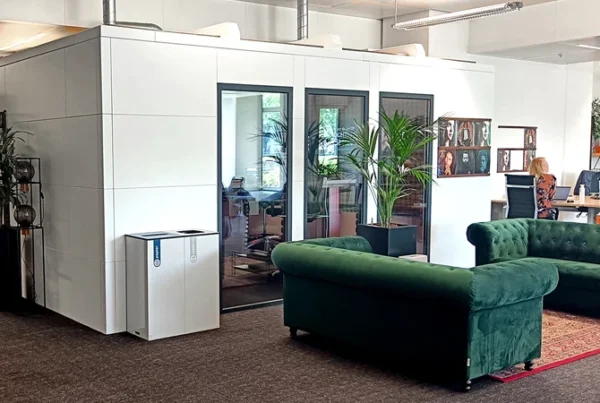
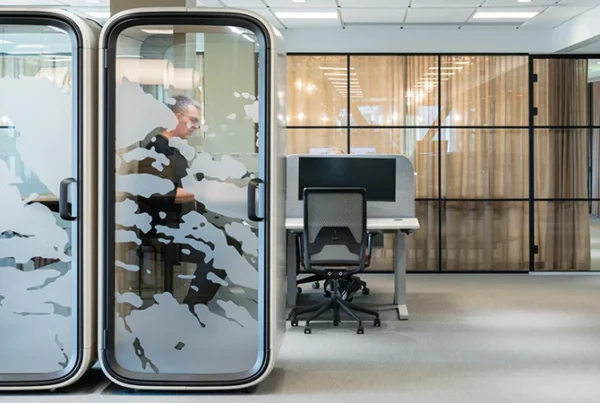
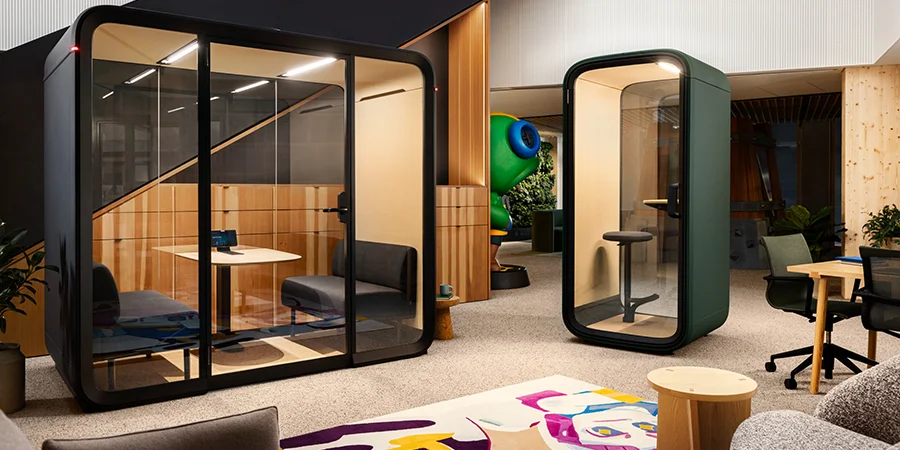
Acoustic booths solve a very specific, very current problem: hybrid teams need private space for video calls, one-on-ones, and small huddles, but very few floor plates were designed with enough enclosed offices to support that at scale. Booths give a developer a fast, modular way to manufacture that privacy without a costly reconfiguration of the base building services. For a tenant sizing up two comparable buildings, the one that already has functioning, well-located acoustic space removes a fit-out cost and a moving-in delay. It’s a tangible answer to the “does this building support the way we actually work” question that enquiry data suggests tenants are now asking upfront.
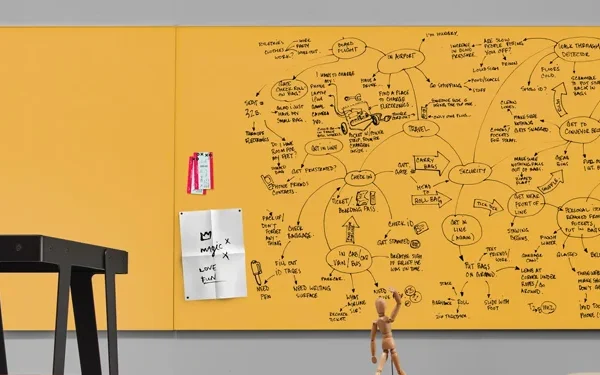
Whiteboard and writable surfaces do the collaborative half of the same job. They turn breakout areas, corridors, and end-of-floor spaces into visibly active, used space, the same signal that spec-suite developers are chasing when they design in café and collaboration zones. A blank meeting room reads as unused overhead. A wall covered in half-erased diagrams reads as a building where work actually happens. For a developer trying to shift a building’s market perception from “ageing C-grade” to “flexible, activated space,” that visual and functional cue is disproportionately cheap for the impression it creates during a tour.
The case for acting now, not later
The Adelaide numbers give this a sense of urgency rather than just opportunity. Enquiry is up 40% quarter-on-quarter, but it is flowing overwhelmingly toward A- and B-grade stock. Older buildings sitting empty aren’t a static problem, they’re a compounding one: Djite’s warning about foot traffic and precinct vibrancy means every quarter a C-grade asset sits vacant, it drags down the leasing case for the buildings around it too.
For developers holding secondary stock, that’s the argument for treating booths and writable surfaces as a defensive investment as much as an offensive one. It’s a comparatively low-cost way to move a building out of the C-grade bucket that’s shedding tenants and toward the profile of building that’s currently absorbing record enquiry. For developers with newer or premium assets, it’s simply table stakes for defending the 10.2% vacancy rate that premium stock is currently enjoying, at a time when tenants have more choice than they’ve had in over a decade.
The flight to quality isn’t really about chasing a grade letter. It’s tenants voting, building by building, for spaces that visibly work the way they now work. Booths and whiteboards won’t turn a C-grade tower into an A-grade one on paper. But they are one of the fastest, most cost-effective ways to give a building the functional and visual proof that it belongs in the part of the market where the enquiry actually is.
Sources: Property Council of Australia national vacancy data, June 2026; Adelaide CBD office market update, August 2026; Propmodo on spec suites and flight-to-quality strategy.