How to choose the right office pod for your workplace
Open plan offices are great for collaboration, right up until someone needs to take a call, run a video meeting or concentrate on a deadline. That is the gap office pods fill. They are freestanding, acoustically engineered rooms that drop into an existing floorplate and give people a quiet, private space without the cost and disruption of building new walls.
But “office pod” covers a lot of ground. A one-person phone booth and a six-person meeting pod solve very different problems, and choosing the wrong mix is one of the most common mistakes we see. This guide breaks down the main types of workplace pods, what to look for in each, and how to work out how many your team actually needs.
What is an office pod?
An office pod is a self-contained, soundproofed enclosure designed to sit inside a building. Most arrive as prefabricated panels and are assembled on site in a few hours, with their own lighting, ventilation and power. Because they are freestanding, they can be moved, reconfigured or taken with you when you relocate, which a built meeting room cannot.
It is worth clearing up one point of confusion early. When you search for office pods in Australia, you will also see backyard studios and garden offices. Those are outdoor buildings for working from home. This guide is about indoor acoustic pods for workplaces, libraries, schools and other shared spaces.
The three main types of office pods
1. Phone booths (1 person, short stays)
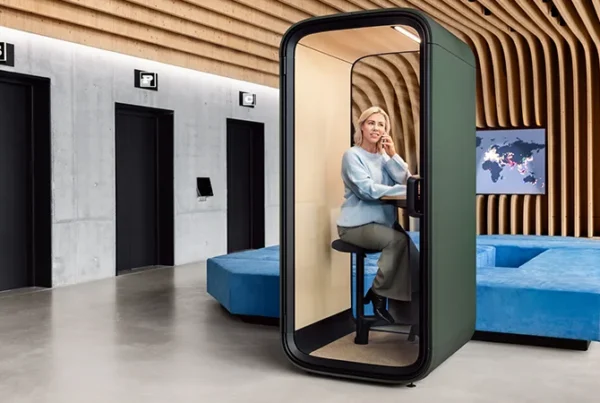
An office phone booth is the smallest type of pod, built for calls, quick video meetings and short private conversations. They typically take up around one square metre of floor space, so they fit into corners, corridors and the edges of open plan areas.
Best for: phone and video calls, confidential conversations, short bursts of focused work.
Look for: a good acoustic rating (more on that below), a camera-friendly lighting mode, a shelf or standing-height work surface, and ventilation that keeps the air fresh even for back-to-back calls.
Example: the Framery One Compact has a footprint of 1.03 m², a 30 dB speech level reduction and a ventilation system that changes the air inside every 42 seconds.
Browse the full range of office phone booths, or read why every hybrid office needs a phone booth.

2. Focus pods (1 person, longer stays)
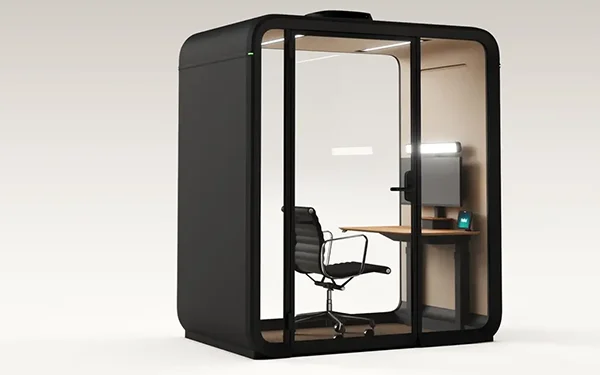
A focus pod is a single-person pod designed for longer sessions of deep work. The difference from a phone booth is comfort: a proper desk, seating you can sit in for an hour or more, and enough room to spread out a laptop and notes.
Best for: deep work, writing, analysis, study, and anyone who struggles with open plan noise and visual distraction.
Look for: a full-size work surface, an adjustable seat or lounge-style seating, power and USB-C charging, and lighting you can set for focus work rather than calls.
Examples: the Framery One (30 dB speech level reduction, GREENGUARD Gold certified) and the Framery One Lounge. For neurodiverse-friendly workplaces, the Loook NeuroPod is worth a look.
See all focus pods.

3. Meeting pods (2 to 6 people)
Meeting pods are small, enclosed meeting rooms that take a fraction of the time and cost of a fitout to install. They are designed for team catch ups, one-on-ones, interviews and hybrid meetings with remote colleagues.
Best for: small team meetings, confidential discussions, hybrid video meetings, interviews.
Look for: a strong acoustic rating so conversations stay inside, ventilation sized for several people, a table and seating that suit the length of your meetings, and video conferencing options such as a screen mount or HDMI.
Examples:
- Framery Four: seats 1 to 4 people with two sofas and a full-size table, 30 dB speech level reduction, and a full air change every 54 seconds.
- Framery Four Accessible: a wheelchair-accessible version for inclusive workplaces.
- Framery Six: up to 6 people, with built-in sound masking and adaptive ventilation.
- JDD Bill, JDD Bob and the Bene NOOXS Think Tank: design-led options for collaborative and semi-open settings.
Compare the full range of meeting pods.

Quick comparison
| Phone booth | Focus pod | Meeting pod | |
|---|---|---|---|
| People | 1 | 1 | 2 to 6 |
| Typical use | Calls, short video meetings | Deep work, longer sessions | Team meetings, hybrid calls |
| Session length | Minutes | Up to a few hours | 30 to 90 minutes |
| Footprint | Around 1 m² | Slightly larger than a booth | Around 3 m² and up |
| Key feature | Small footprint, call lighting | Comfortable desk and seating | Ventilation for groups, AV options |
How soundproof is a soundproof office pod?
No pod is completely silent, and any supplier who says otherwise is overselling. What you should compare is the pod’s speech level reduction, measured under the international standard ISO 23351-1. It tells you how much quieter speech is outside the pod than inside it, and gives each pod a class:
| ISO 23351-1 class | Speech level reduction | What it means in practice |
|---|---|---|
| A | 30 dB or more | Highest class. Speech privacy in most offices |
| B | 25 to 30 dB | Good speech privacy |
| C | 20 to 25 dB | Privacy depends on background noise |
| D | 15 to 20 dB | Privacy depends on background noise |
If confidentiality matters (HR conversations, legal, health or client calls), aim for Class A or B. Be wary of pods that quote a single “noise reduction” figure without saying which test standard it comes from, because results from different methods are not comparable.
How many office pods do you need?
Framery’s own planning guide recommends:
- One phone booth or one-person pod for every 10 employees
- One four-person meeting pod for every 20 employees
- One six-person meeting pod for every 30 employees
For a 60-person office, that works out to roughly six one-person pods, three four-person pods and two six-person pods. Treat this as a starting point rather than a rule. Teams that spend most of the day on calls (sales, recruitment, customer service) usually need more phone booths, while teams with lots of internal collaboration lean towards meeting pods.
The most reliable way to size your mix is to look at how your current spaces are used. Framery’s smart office tools can show occupancy in real time once pods are installed, which makes it easy to tell when you need more.
What to check before you buy
1. Acoustic rating and test standard. Ask for the ISO 23351-1 class, not just a dB number.
2. Ventilation. A pod without enough airflow becomes stuffy within minutes and people stop using it. Look for the airflow rate in litres per second and how often the air is fully changed.
3. Footprint and access. Measure doorways, lifts and corridors as well as the final position. Allow clearance for the door to open and for wheelchair access where required.
4. Fire safety and your building. Ask your supplier for the pod’s material fire classifications, and check with your building manager or fire consultant early. Some pods are designed so that sprinklers are not needed inside them, but requirements can vary depending on the building and local fire authority.
5. Power and technology. Check what is standard and what is optional: power outlets, USB-C charging, LAN, HDMI, screen mounts and booking or occupancy sensors.
6. Mobility. If your layout changes often, choose pods that can be fitted with castors or easily relocated.
7. Sustainability. Look for certifications such as GREENGUARD Gold for indoor air quality, and ask about end-of-life recyclability.
8. After-sales support. A pod is a long-term asset. Ask who handles warranty claims, spare parts and relocation if you move. Framery products, for example, carry a 5-year warranty on wear parts.
Not just for offices
The same pods work well anywhere people share space but need privacy. Libraries, universities and schools use them as bookable study and meeting spaces. Hobsons Bay City Council, for example, installed a Framery 2Q at Williamstown Library for private meetings, group work and quiet study. You can read more about pods in education in how Framery pods transform learning environments.
For recording, podcasting and voice-over work, which need a higher level of sound isolation than a standard office pod, see our guide to room-in-a-room soundproofing and our Studiobricks booths.
Frequently Asked Questions
What is an office pod?
An office pod is a freestanding, soundproofed enclosure that sits inside a building to create a private space for calls, focused work or small meetings. It has its own lighting, ventilation and power, and can be installed or relocated without building work.
How much does an office pod cost?
Price depends mainly on size, acoustic performance, ventilation, built-in technology and delivery and installation. As one example, the Studiobricks One is listed on Envoy’s site from $16,970 including delivery and installation. For an accurate figure for your space, request a quote from the Envoy team.
Why are office pods expensive?
A quality pod is closer to a small engineered room than a piece of furniture. The price reflects multi-layer acoustic construction, tested ventilation, safety-rated materials, integrated lighting and power, and the testing needed to certify performance under standards like ISO 23351-1. Compared with building a new meeting room, a pod is usually faster to install and can move with you when you relocate.
Do you need a permit for an office pod?
Indoor office pods are freestanding units, so they generally do not need the approvals that come with building new walls. You should still check with your building manager or fire consultant before installation, particularly about sprinklers and fire detection, as requirements can vary between buildings. Backyard office pods are a different category and may need council approval.
What is the difference between a phone booth and a meeting pod?
A phone booth is a one-person pod for calls and short tasks, with a footprint of around one square metre. A meeting pod holds 2 to 6 people, with seating, a table and ventilation sized for a group.
How many office pods do I need?
Framery recommends one single-person pod for every 10 employees, one four-person pod for every 20 employees and one six-person pod for every 30 employees. Adjust for how much time your team spends on calls versus in meetings.
See them in person
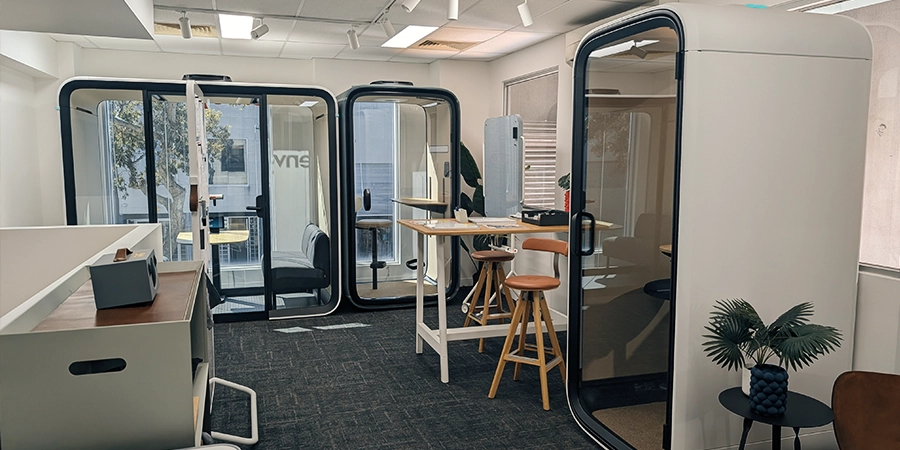
Specifications only tell part of the story. The best way to choose an office pod is to step inside one, close the door and hear the difference. Book a visit to one of Envoy’s showrooms in Melbourne, Sydney or Brisbane, or explore the full range of office pods and booths online. Our team can also help with acoustic testing, layout planning and ongoing maintenance.