Panels or pods? It depends on the kind of noise
Acoustic panels and office pods solve two different noise problems. Panels soak up echo so a busy room feels calmer. Pods stop a conversation from reaching the desks around it. Most open-plan offices need a bit of both, and knowing which problem you actually have will save you money.
If your team complains that the office is “loud”, the fix depends on what they mean. A room that rings and builds up a constant hum is an absorption problem. A colleague’s phone call that you can follow word for word is a privacy problem. This guide explains the difference, compares the two solutions side by side, and shows how to combine them.
Why open-plan noise is still a problem
The noise that hurts focus most is not loud noise. It is speech you can understand. Your brain can’t help following a nearby conversation, so it pulls attention away from the task in front of you.
The research is consistent on this:
- In a lab study of simulated open-plan noise, raising background sound by 12 dB (from 39 to 51 dB) significantly worsened word recall, and participants reported feeling more tired and less motivated.
- In occupied offices, people working in open-plan areas scored 14% lower on cognitive tests than people in private offices.
- A study of workers exposed to three hours of open-office noise found raised adrenaline levels and less persistence on a difficult task.
Hybrid work has made this worse, not better. More of the day is now spent on video calls, often from a desk in the middle of the floor. That means more speech in the room, and more people trying to concentrate around it.

What acoustic panels do well
Acoustic panels absorb sound energy instead of letting it bounce off hard surfaces. Modern offices are full of glass, concrete, plasterboard and polished floors, so sound reflects around the room and builds into a background roar. Panels cut that reflection, or reverberation.
A panel’s performance is measured by its Noise Reduction Coefficient (NRC), a score from 0 to 1 averaged across the main speech frequencies. An NRC of 0.8 means the panel absorbs about 80% of the sound that hits it. Quality felt panels typically sit between 0.70 and 0.95, depending on thickness and how they are mounted.
Panels are the right tool when:
- The room sounds echoey or “hard”, especially meeting rooms and breakout areas
- Noise builds up through the day until everyone is talking louder
- Video calls sound hollow to people on the other end
- You want to improve a whole floor without changing the layout
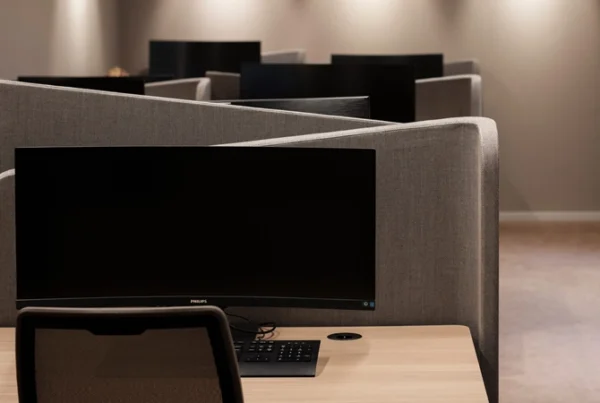
They also double as design pieces. Wall panels, ceiling baffles and freestanding screens, like the felt ranges from HEY-SIGN, add colour and texture while they work. For best results, place absorbers on at least two non-parallel surfaces, such as a wall and the ceiling.
Browse Envoy’s acoustic elements.
What acoustic panels can’t do
Panels absorb sound. They don’t block it. A conversation two desks away still travels straight to your ears before it ever reaches a wall or ceiling panel. Panels make that conversation a little softer and less echoey, but you can usually still understand every word.
That matters because understandable speech is the main source of distraction. So panels alone won’t fix:
- Phone and video calls at desks. The caller still disturbs the people nearby, and the people nearby can still hear the call.
- Confidential conversations. HR chats, client calls and performance reviews need speech privacy, not just a quieter room.
- Deep-focus work. Someone writing a report or checking a design needs a space where speech can’t reach them.
To stop sound travelling from one person to another, you need an enclosure with mass and seals. That is where office pods come in.
Office pods explained
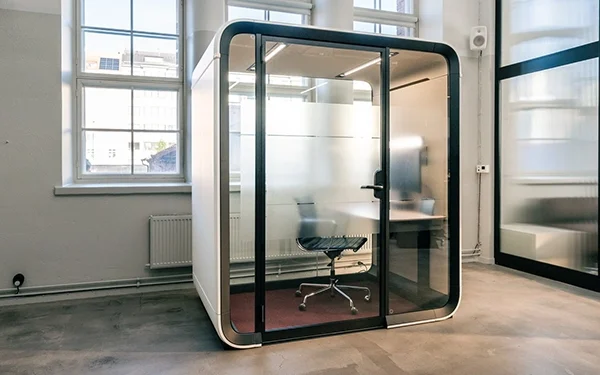
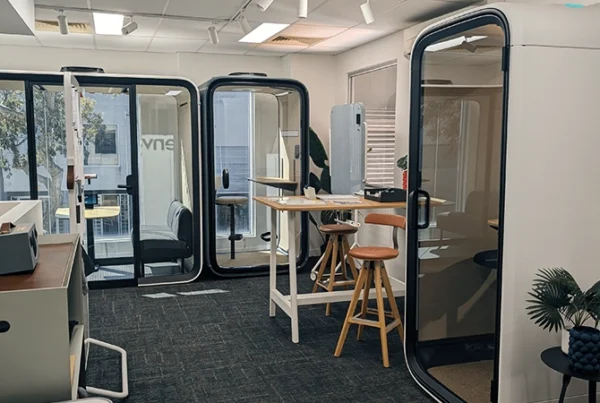
An office pod is a freestanding, enclosed room that sits on your existing floor. Good pods are built to keep speech in and office noise out, with their own ventilation and lighting. Because they are furniture, not construction, they can be installed in a day and moved when your layout changes.
The key number is speech level reduction, measured under the international standard ISO 23351-1. Framery’s pods are rated at 30 dB, which is Class A, the top rating for office booths. As a rule of thumb, a pod with more than 25 dB of speech reduction can sit right next to workstations without disturbing them.
Pods come in three main types:
| Type | Seats | Best for | Example |
|---|---|---|---|
| Phone booth | 1 | Calls, video meetings, short focus sessions | Framery One Compact |
| Focus or work pod | 1 | Longer solo work, video calls, deep focus | Framery One, Framery One Work |
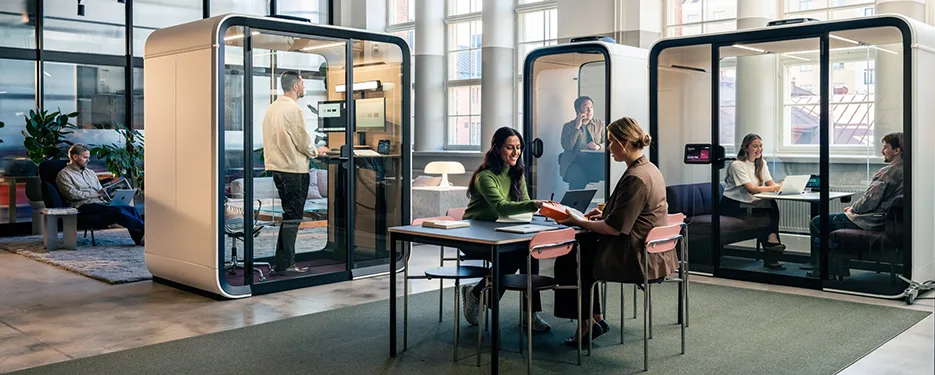
| Meeting pod | Up to 6 | Team catch-ups, interviews, hybrid meetings | Framery Four (up to 4), Framery Six (up to 6) |
When comparing pods, check the tested speech reduction figure (not just “soundproof” claims), ventilation, lighting for video calls, and whether the pod meets local fire and accessibility requirements.
See Envoy’s range of phone booths, meeting pods and all pods and booths.
Acoustic panels vs office pods at a glance
Panels improve the whole room a little. Pods give a few people complete privacy.
| Acoustic panels | Office pods | |
|---|---|---|
| What it does | Absorbs echo and reverberation | Blocks speech from leaving or entering |
| Fixes | A loud, echoey room | Calls, confidential chats, deep focus |
| Speech privacy | Low | High (look for a tested ISO 23351-1 rating) |
| Coverage | Whole room or floor | The people inside the pod |
| Installation | Wall, ceiling or freestanding; minimal disruption | Delivered and assembled, usually in a day |
| Flexibility | Fixed panels stay put; screens can move | Can be relocated or taken to a new office |
| Cost | Lower per square metre | Higher per unit, but cheaper and faster than building a room |
| Design impact | Adds colour and texture | Adds a visible, bookable destination |
Choose panels first if your main complaint is general noise, echo or poor call quality from meeting rooms.
Choose pods first if your main complaint is overheard calls, a lack of private space, or people leaving the office to concentrate.
The best answer is usually both
The most comfortable workplaces combine the two. Panels lower the background level across the floor, and pods give people a place to go when they need privacy or quiet. Each makes the other work better: calls move into pods, so there is less speech for panels to deal with, and a calmer room makes the time outside the pod more productive.
A simple way to plan it:
- Map the noise. Walk the floor at a busy time and note where calls happen, where people gather, and where people try to focus.
- Treat the hard surfaces. Add panels or ceiling baffles to meeting rooms, breakout areas and any space with lots of glass or concrete.
- Give calls a home. Place phone booths close to the desks that make the most calls, so walking to one is easier than staying put.
- Add meeting pods where rooms are scarce. A four or six-person pod can take pressure off fully booked meeting rooms without a fit-out.
- Zone the floor. Keep collaboration areas away from focus zones, and use freestanding acoustic screens to separate them.
Frequently asked questions
Do acoustic panels make a room soundproof?
No. Acoustic panels absorb echo inside a room, but they don’t stop sound passing through walls or across an open floor. For privacy you need an enclosed space, such as an office pod or a properly built room.
What is a good NRC rating for office acoustic panels?
For offices, look for panels with an NRC of 0.7 or higher. Thicker panels and panels mounted with an air gap behind them usually absorb more.
How soundproof is an office pod?
It depends on the pod. Look for a speech level reduction figure tested to ISO 23351-1. Framery pods are rated at 30 dB (Class A), and pods above 25 dB can usually sit next to desks without disturbing them.
Do office pods need building approval?
Most office pods are freestanding furniture, so they don’t usually need building works. Check with your building manager about fire systems, power and any tenancy rules before installing.
How many phone booths does an office need?
There is no fixed rule. Start by counting how many people are on calls at the same time during your busiest hour, then add booths near the teams that make the most calls.
Can I use acoustic panels and pods together?
Yes, and it is usually the best approach. Panels calm the overall room, and pods give people privacy for calls and focused work.
Find the right mix for your workplace
If your office sounds loud and echoey, start with acoustic panels. If people can’t take a call or concentrate without being overheard, start with office pods. If it’s both, which it usually is, plan them together.
Envoy supplies acoustic elements from HEY-SIGN and pods and booths from Framery, Studiobricks and Bene across Australia. Our team can help you work out what your space actually needs, from a single phone booth to a full acoustic plan.