From simple soundproof booths to smart pods
When Framery built its first office pod in a Tampere garage in 2010, the goal was simple: block noise. Fifteen years later, the same category of product can sense when you walk in, choose your lighting for you, and adjust its own airflow before you’ve sat down. The acoustic engineering that made Framery famous hasn’t disappeared, it’s just no longer the whole story. Here’s how the technology inside the booth itself has changed, generation by generation.
The early years: soundproofing first, everything else second
Framery’s first pods, including the 2013 Framery O, were built around one problem: speech reduction. The O was the first pod to reach 30dB of noise reduction, achieved almost entirely through wall structure and sealing rather than electronics. Ventilation was mechanical but passive, enough airflow to stop the pod feeling stuffy, with no sensors and no automation. Larger models like Framery Q and 2Q followed the same formula, scaled up for two to four people. For most of the 2010s, a Framery pod was, in effect, a very well-engineered box.
2021: the first shift toward video-aware design
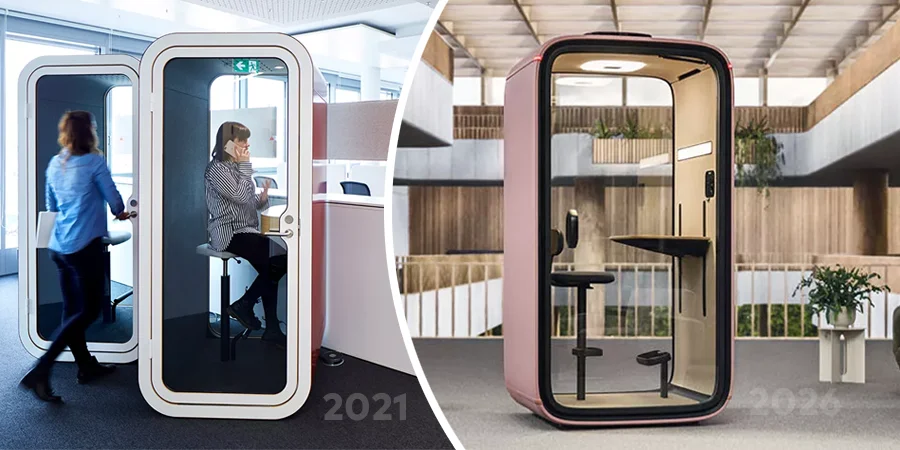
Framery One, launched in 2021, marked the first real change in what the pod was designed for. Rather than just phone privacy, it was built around video calls, which meant lighting and camera positioning became design considerations for the first time. It was a small step technologically, but it set the direction: the pod needed to think about how the person inside it was being seen and heard, not just how well it kept sound out.
2024: the smart pod generation
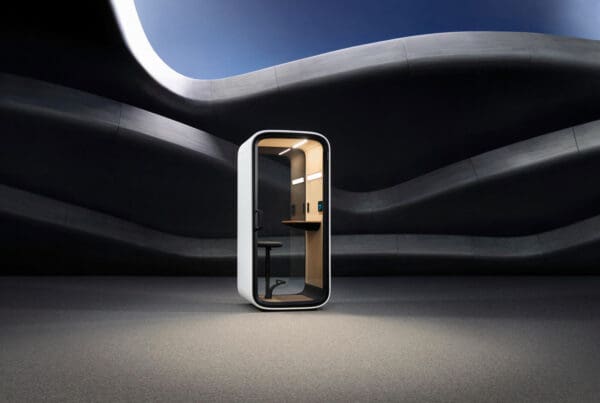
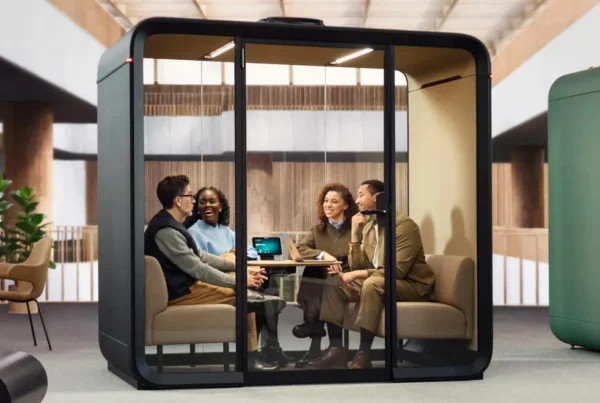
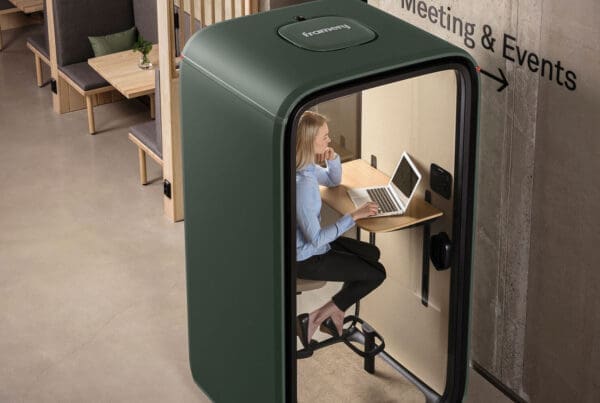
The biggest technical leap came in March 2024, when Framery replaced its O, Q and 2Q lines with a new “smart pod” range: One Compact, One, Four and Six. This is where sensors, lighting and ventilation moved from static features to automated systems.
Sensors. Smart pods use mmWave radar, the same sensor technology used in autonomous vehicles, to detect when someone enters or leaves. That single input now drives most of the pod’s automation: lighting and airflow adjust without anyone touching a switch, and exterior status lights show at a glance whether a pod is free, in use, or about to become available. A built-in 4G connection also lets the pod receive software updates over the air, independent of the office Wi-Fi, so functionality can keep improving after installation.
Lighting. Instead of one fixed light setting, smart pods switch between presets based on context. An in-person mode mimics natural daylight for focus work, while a video-call mode is tuned specifically to how it renders faces on camera. The pod effectively chooses the right lighting for what you’re doing, rather than leaving it to a dimmer switch.
Ventilation. Airflow became adjustable between direct and indirect settings, controlled from a touchscreen, so users can choose whether air moves across them or circulates around the space. On average, the air inside a smart pod is fully exchanged roughly every 60 seconds, a meaningful step up from the passive ventilation of the O and Q generation.
Acoustics also had a quiet upgrade alongside the electronics. Smart pods use a patent-pending structure tuned specifically to human speech frequencies, and an external sound-masking layer reduces how intelligible conversations are to people standing nearby, something earlier pods didn’t attempt.
Can an older Framery O be upgraded?
Buying a new pod isn’t the only way to bring an older fleet up to date. Envoy’s upgrade path for the Framery O shows an existing pod can be retrofitted with several of the features that define the smart pod generation, without replacing the unit:
Room Sensors can be fitted to an existing O, so older and newer pods can be reviewed as part of the same fleet using the same occupancy data as the current smart pod range.
Self-closing hinges can be retrofitted to limit how far a door swings open, so it doesn’t block a walkway or passage.
PixelTUF adds an in-pod power point that discreetly combines a standard mains socket with Power Delivery USB-C fast charging, in a compact, unobtrusive fitting.
A Movability Kit adds castors so a Framery O can be relocated without disassembling it, useful for offices that shift layouts more often than they replace furniture.
Together, these mean an older Framery O doesn’t have to be written off once newer pods arrive. Sensors, power and hardware can be upgraded in place, extending the working life of the fleet rather than replacing it outright.
What this means for offices today
The arc is clear: Framery spent its first decade perfecting the box, then spent the last few years teaching the box to respond to the person inside it. A pod bought in 2013 and a pod bought today solve the same core problem, unwanted noise, but the newer generation does it while also managing light, air and its own upkeep with far less input from the people using it.
For workplaces choosing between models, that shift matters practically as well as technically: sensor-driven automation means less manual adjustment for staff, and over-the-air updates mean the pod you install today isn’t the final version of what you own.
To see the current smart pod range, including the Framery One, Four and Six, visit Envoy’s Framery collection.